
EMC Testing
Electromagnetic Compatibility (EMC) is a series of tests that check a product can exist in the real world, will not unduly affect other products around it, and will not be unduly affected by other nearby products. If we think back to the early 2000’s, our old Nokia phones produced a rhythmic clacking sound on old PC speakers, just before a text message was received. This isn’t supposed to happen and is a good example of EMC failure. When was the last time you heard this?
There are essentially only 2 types of EMC test:
- Emissions: What a device emits. Tested against a series of limits.
- Immunity: How susceptible a device is to the environment around it. Usually tested by monitoring the performance of the Device under Test (DuT) or sometimes Equipment under Test (EuT).
Hopefully, when an organisation is preparing for formal compliance testing, the standards that need to be applied will have been determined early in the process. Let’s use the same example as our previous article – a hand-held product which measures sound pressure. It has a Bluetooth connection, USB charging and a simple user interface consisting of an LCD screen.
In this case, we will apply EN 61010-1 for safety (LvD) and EN 61326-1 for EMC.
From EN 61326-1, we can make a list of the areas which will need to be tested to show that the product complies with the EMC directive. This list should also be produced in the test plan by the test house and is normally outlined in their quote. Typically, this may include:
- Radiated emissions : Applies
- Radiated Immunity : Applies
- Electrostatic discharge : Applies
- Conducted Emissions : Does not apply to our example
- Conducted immunity : Does not apply to our example
- Power frequency magnetic fields : Does not apply to our example
- AC / DC / signal power bursts : Does not apply to our example
- AC /DC /signal power surge : Does not apply to our example
- Conducted RF on AC cables : Does not apply to our example
- Voltage dips : Does not apply to our example
- Short power interruptions : Does not apply to our example
The ranges and limits of each test will also be set. For example, if our product is going to be used in an industrial environment, it will need to withstand a higher level of external noise. The Radiated Immunity applied field will be set to 10V/m. For a domestic product, this is set to 3V/m. If a product is to be used in both industrial and domestic settings, the “worst” or “toughest” tests are used.
We also need to consider operating modes where typically a change of state could be an issue. If, when the unit is off, it cannot be turned on without some form of physical interaction (such as a physical switch) this is not normally tested. If the power is applied via a soft switch, this would need testing. In our example, let’s imagine the user interface is a membrane keypad and the power button connects to a micro pin. We have 3 modes – standby, charging and measuring. For each of these modes the tests from the list above need to be run.
Radiated tests are generally carried out in an anechoic chamber. All other tests are carried out in a shielded room.
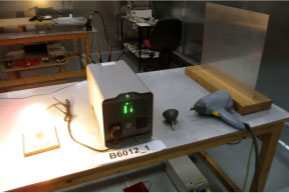
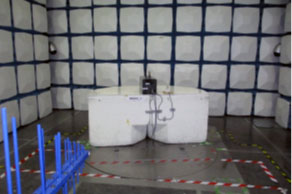
Radiated emissions, carried out in an anechoic chamber
What happens at the test house?
When you present your product to the test house, the test engineer will set up each test in line with the configuration described in the standard. The test will run, in each mode, and the device will either pass or fail. In some cases, if the device fails, the test may be re-run to check that it is repeatable. Some labs may allow you to attend to see the tests, known as witness testing.
So, where does Cubik EPS fit in?
Cubik EPS has been through this process many times with many products. As well as our in house pre-compliance test capabilities, which can de-risk this process, we can help with the production of the documentation, generating the Declaration of Conformity (DofC), onsite support at the test house and debug of issues that may arise during the testing process. Our experience in this area often speeds up the duration of this process, especially when other territories (and therefore other marks) are needed, for example USA, Canada, Australia, Japan etc.
EMC take-away
It is always best to complete all tests before starting a debug exercise because if there is an issue it may be replicated in other tests. For example, if a failure is seen in radiated emissions, this may also be seen in radiated immunity and having the big picture can help you get to the bottom of the issue.
In our experience, the biggest point of failure is often a switch on the end of a wire. The wire acts as an antenna and couples’ noise into and out of the PCB, resulting in the unit failing radiated emissions and radiated immunity. A ferrite on the wire can fix this and thankfully test houses often have a ready supply of these. But bear in mind that if you add a ferrite at the test house, you will need to include it in your production Bill of Materials (BoM).