
Compliance: What is it and do I need it?

It is a legal requirement that all electronic products placed on the market in the European Union (EU) carry the CE mark. In 2021, the laws were updated for England, Scotland and Wales meaning products can also carry the UKCA mark.
So, what are these marks, what do they mean, and how does a manufacturer get one?
As a company specialising in electronic products, we are often asked these questions and, following the UK’s departure from the EU, things have changed. This article aims to demystify the little mark on the back of a product and take the “black magic” away from getting one.
Whilst there are many other marks used around the world, such as the FFC mark, which is used in the USA, this guide only covers UKCA and CE.
So, what is it all about?
This process is not a hurdle, its due diligence.
UKCA and CE marks are recognised marks that indicate that a product has been “vetted” and checked that it complies with a series of applicable standards. The standards that need to be applied depend on what the product is, where it will be used and what is contained within. Let’s consider a simple, hand-held product with a Bluetooth connection, USB charging and a simple user interface, such as an LCD screen. The manufacturer will need to apply:
- The Radio Equipment Directive (ReD)
- The Low Voltage Directive (LvD)
- The Electromagnetic Compatibility (EMC) Directive
- Reach
- RoHS
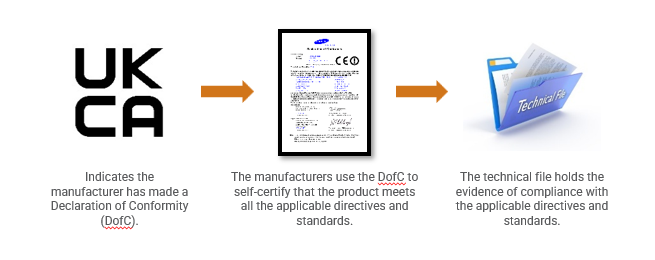
Directives (Regulations in the UK) are controlling documents that direct what compliance is necessary. For a product like the one we’ve described, the mark is self-certified. This means the manufacturer produces a Declaration of Conformity (DofC) which declares how each of the directives have been met.
There are other directives that may be applied such as the Machinery Directive, or the Medical Devices Directive, etc. which make the work that must be carried out broader. As a result, it may not be possible to self-certify these products and they may need to be reviewed by an approval body.
It’s worth noting that we haven’t mentioned a test house yet. We’ll come back to this.
The information that is required to support the compliance mark is collated and put into a technical file. Without the technical file, the mark and the DofC are not valid. The technical file is likely to contain some of your IP. It is unlikely that you will need to release this to anyone apart from a compliance officer, and they are only likely to ask for it if something has gone wrong. However, you must hold the technical file for as long as the product is available on the market, and for many years after.
A useful way to consider the marking process is the chain of command, shown below:
So, what are standards, and when do I need the test house?
Looking back at our list, we can see that we need to comply with the Low Voltage Directive (LvD). Thinking back to our hand-held product, if we say that the device measures a property, for example, sound pressure, an appropriate standard that might be applied would be EN 61010-1 – Safety requirements for electrical equipment for measurement, control, and laboratory use.This standard is around 180 pages and details exactly what is required to meet the LvD. In many cases, there may be several other sub parts of the standard which need to be applied, and other standards are often called up.
Moving on from LvD, we can see that we also need to apply the EMC directive. For a measurement product like our example, the appropriate EMC standard would be EN 61326-1. This standard sets out how we need to test the product and what limits should be applied to determine pass/fail criteria. It also calls on many other standards, such as IEC 61000-4-2 which details the Electrostatic tests that the equipment needs to withstand.
Most companies do not have the equipment needed to perform the EMC and safety tests that must be carried out. This is usually the point at which the test house is engaged. Referring to the list above, EMC and safety testing accounts for quite a small proportion of the overall compliance requirements, meaning, a company can carry out most of the process without a test house.
So, where does Cubik EPS fit in?
In this series, I am offering a take-away at the end of each article. On this occasion, I would like to consider the UKCA mark which was introduced when the UK exited the EU. In January 2023, it became mandatory, and the CE mark was no longer applicable in the UK.
Since then, the UK government has re-recognised the CE mark. If you are going through this process with a product, there is little additional effort in marking for both UKCA and CE as the technical file can be shared with the exception of the DofC. Our recommendation would be to apply for both marks and generate 2 DofC’s – one for CE and one for UKCA.
You never know what may happen in the future!
Compliance take-away
In this series, I am offering a take-away at the end of each article. On this occasion, I would like to consider the UKCA mark which was introduced when the UK exited the EU. In January 2023, it became mandatory, and the CE mark was no longer applicable in the UK.
Since then, the UK government has re-recognised the CE mark. If you are going through this process with a product, there is little additional effort in marking for both UKCA and CE as the technical file can be shared with the exception of the DofC. Our recommendation would be to apply for both marks and generate 2 DofC’s – one for CE and one for UKCA.
You never know what may happen in the future!

Contact Paul for a free 30-minute consultancy